
Law-Firm Letterhead Does Not Make Nevada HOA Law
What exactly do HOA owners get to decide?
Sun City Summerlin’s board wanted to join the growing lawsuit challenging the Southern Nevada Water Authority’s (SNWA) artificial-turf mandate.
The account that follows is based on information and documents provided to the Coalition by a Sun City Summerlin owner. We have not independently verified every factual detail, and the association may have additional information or a different account of what occurred.
Ordinarily, Nevada law requires owner approval before an HOA commits the association to civil litigation of this kind. But there is an exception for litigation involving the health, safety and welfare (HSW) of the association’s members. According to the information provided to the Coalition, the Sun City Summerlin board treated the turf dispute as a health, safety and welfare matter.
That classification mattered enormously—and should frighten every Nevada HOA owner.
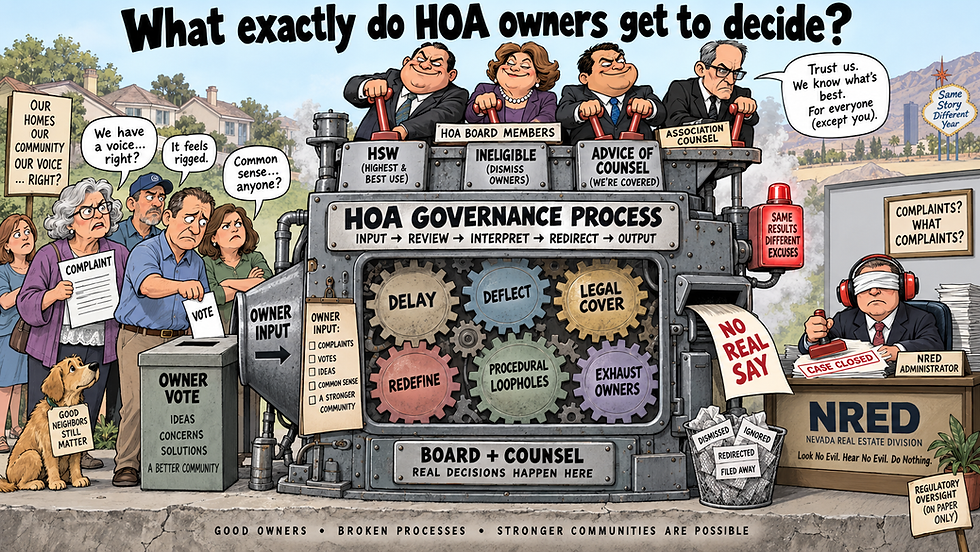
It allowed the board to enter the litigation without first obtaining the owner vote that otherwise would have been required. This time, the litigation was against SNWA. Next time, who knows? It could be an owner—or a class of owners.
Think about what that means. By labeling the turf dispute a health, safety and welfare matter, the board effectively decided for itself that the normal owner-vote requirement did not apply. Many owners may find the characterization itself surprising. A fight over a water district mandate requiring removal of grass for artificial turf is not what most people would instinctively think of when they hear the words “health, safety and welfare.”
But right or wrong, the classification went unchallenged—and there may have been no practical way for owners to challenge it before the board acted. The classification opened a statutory door that Nevada has left dangerously wide. As we discussed in A Dangerous New Weapon, lawmakers gave “health, safety and welfare” extraordinarily broad treatment, and the regulation just adopted by the CIC Commission supplied few meaningful guardrails.
There was still an important safeguard.
NRS 116.31088 says that when a board commences qualifying health, safety and welfare litigation without advance owner approval, the action “must be ratified” within 90 days by the required vote of the owners. A vote was taken. It is reproted Sun City Summerlin did not obtain that majority ratification. Yet association counsel advised that the lawsuit could continue anyway. In substance, his interpretation is that even though the required majority did not vote to ratify the lawsuit, the board is not required to stop pursuing it.
Now the problem should be coming into focus. First, the board classified an artificial-turf dispute as a HSW matter and thereby bypassed the owner vote normally required before entering the litigation. Then the owners actually voted—and the board did not obtain the majority required to ratify what it had done. And counsel’s interpretation is that the litigation may nevertheless continue.
So what exactly did the owners get to decide?
That question should concern every Nevada HOA owner, because this is no longer just about artificial turf or one Sun City lawsuit. It is about who gets to decide what Nevada HOA law means.
NRED’s own training material (slide #24) tells owners that if a civil action is commenced without the required advance vote, the action “MUST be ratified within 90 days by a majority of unit owners.” Counsel’s own pre-vote letter shows how he argues the statute should be read. Counsel’s pre-vote letter to Sun City Summerlin owners can be found here.
It first quotes NRS 116.31088, echoing NRED, requiring that the action “must be ratified within 90 days.” But it then points to the statute’s next sentence, which says the association “may thereafter seek to dismiss” if it cannot obtain the required vote. Counsel reads that “may” as making dismissal discretionary and describes the process as “somewhat analogous to a budget ratification vote.” Notably, NRED’s own training material makes no similar assertion.
To be clear, Nevada HOA boards should seek legal advice. But in doing so they must keep in mind what counsel provided: an opinion. And as we all know, everyone has one. It is not precedent. It does not bind a court, NRED, the CIC Commission, or anyone else charged with interpreting Nevada law. A lawyer’s opinion does not become Nevada law simply because it arrives on law-firm letterhead.
We read “may seek to dismiss” more narrowly. In our view, lawmakers left the board procedural latitude after ratification fails—for example, to seek a stay while another vote is pursued, or to take some other step short of simply continuing the case as though the owners had approved it.
But the statute does not say that failure to obtain ratification becomes permission to keep litigating. The mandatory language remains: the action “must be ratified.” Read as a whole, the statute appears designed to halt the association’s unilateral prosecution of the case once the required owner ratification fails—not to convert that failure into approval by default. That creates the tension at the heart of this example: the action “must be ratified,” yet counsel’s interpretation allows it to continue even when that required ratification is not obtained.
Counsel has one interpretation. We - as do apprarently many owners- have another. He is allowed to make a legal argument. But that leads to the much larger question: Who independently decides whether counsel is right?

Who independently decides?
If the board relies on counsel’s interpretation, and NRED the board’s reliance on counsel as sufficient evidence that the board acted on an informed basis, the legal opinion can become functionally self-validating. The board says it acted because counsel said it could. The regulator says the board acted responsibly because it relied on counsel. And the underlying question—did Nevada law actually authorize what the board did?—may never receive independent scrutiny.
Advice of counsel may help establish that a board informed itself before acting. It does not establish that the board possessed the legal authority counsel said it had.
And it certainly should not allow a legal opinion to become, for all practical purposes, Nevada law simply because no one in the regulatory system is willing to test it.


Comments